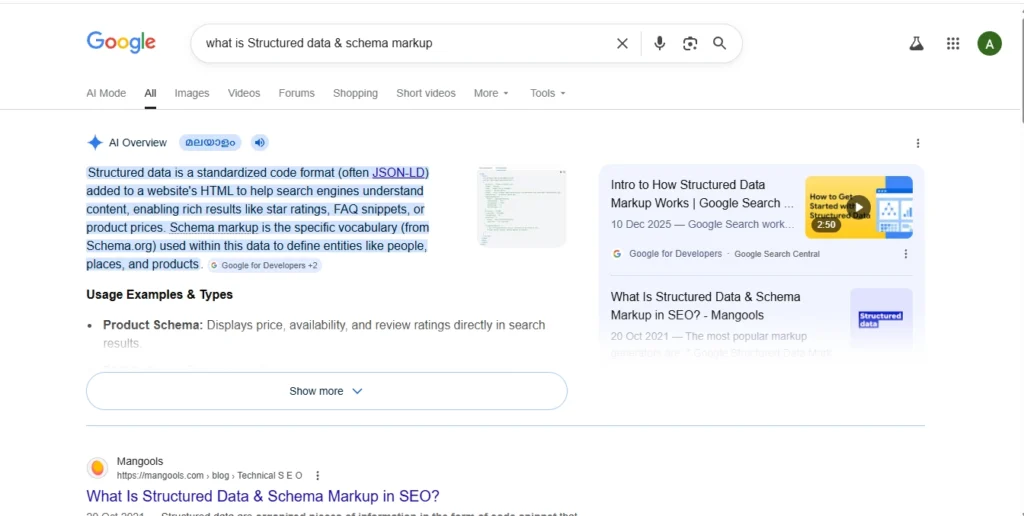

How to Add Schema Markup in Website: Advanced Guide for AI Engine Citations
Imagine an AI crawler landing on your webpage. Without clean structure, that crawler must guess your context, often resulting in ignored content or incorrect citations in AI Overviews. Knowing how to add schema markup in website setups bridges this communication gap immediately. It acts as a direct, machine-readable passport for search bots.
As engines like Perplexity, ChatGPT, and Google AI Mode answer queries directly, standard SEO rules are shifting. If you want these generative engines to cite your brand as an authority, you must feed them structured data. Let’s look beyond the basic tutorials and master a strategy optimized for AI retrieval-augmented generation (RAG) models.
Table of Contents
- 1. The New Era of AI Search Engine Citations
- 2. Does Structured Data Actually Drive AI Citations?
- 3. Priority Schema Types Ranked by AI Impact
- 4. A Step-by-Step Guide on How to Implement Schema Markup
- 5. Common Technical Mistakes to Avoid
- 6. Comparing Schema Performance Metrics for AI Discovery
- 7. Frequently Asked Questions (FAQ)
- 8. Conclusion
Key Takeaways
- AI Infrastructure: Schema acts as a foundational database that feeds AI knowledge graphs.
- Underdeployed Opportunity: The Identity Layer (Organization and WebSite) is heavily underdeployed but critical for domain verification.
- Realistic Metrics: Industry data indicates schema acts as a gateway for uncrawled or obscure content, rather than a magic ranking boost for already-popular pages.
- Nesting is King: Combining FAQ, Article, and Breadcrumb schemas can boost citation potential up to twofold.
1. The New Era of AI Search Engine Citations
Generative search engines require explicit entity data to retrieve, synthesize, and cite web pages accurately. While traditional search relies on keywords and links, AI search platforms use structured data to verify facts and construct direct answers. This transition means schema has shifted from an optional design rich snippet to essential crawl infrastructure.
Traditional search engines return lists of blue links. AI systems, however, retrieve content from diverse sources, synthesize it, and deliver a single direct answer. Some industry estimates suggest that up to 93% of AI-driven queries are answered without a user click.
How do you survive this landscape? You make your content effortless for LLMs to extract. Because large language models function as pattern-matching machines rather than reasoning tools, they rely on explicit context. Providing this context via JSON-LD allows bots to map your content directly to existing knowledge bases.
2. Does Structured Data Actually Drive AI Citations?
The latest industry data shows a nuanced relationship where structured data serves as foundational infrastructure rather than a guaranteed citation ranking factor. Adding markup has little immediate citation boost for websites that are already regarded as highly authoritative, but it greatly increases the visibility and indexation of newer or less crawled websites.
Several vendor-published analyses report highly optimistic figures. According to some agency reports, for example, adequate schema coverage can raise the likelihood of an AI citation by as much as 36%. Other case studies suggest that comprehensive markup yields a 2.5x higher chance of appearing in AI Overviews, while a 2026 arXiv paper notes a 29.6% to 29.8% lift in RAG accuracy when using entity-enriched JSON-LD.
Let’s look at the skeptical, data-driven counter-case. A large-scale controlled study by Ahrefs tracking schema changes analyzed 1,885 pages that added JSON-LD compared to 4,000 control pages. The result? Adding schema produced no major citation uplift on any generative search platform for pages that were already highly cited.
In my experience, many agency studies confuse correlation with causation. Adding schema won’t automatically increase ChatGPT’s trust in your website if your content lacks baseline authority and depth. It works best when combining high-quality copywriting with a pristine, machine-readable backend. The goal is to make learning how to implement schema markup a core priority of your technical strategy.
3. Priority Schema Types Ranked by AI Impact
The schema types that yield the highest impact for AI visibility are those that establish identity, format query answers, and verify content freshness. Specifically, deploying Organization, FAQPage, and Article markup provides the strongest machine-readable signals for AI parsers. Focusing on these high-priority types ensures that search bots map your entities correctly.
When planning how to add schema markup in website architectures, focus on these priority types:
Identity Layer: Organization, WebSite, and WebPage
This is the most underdeployed layer with the highest citation value. Interestingly, HTTP Archive Web Almanac data reveals that WebSite schema is present on only 12.7% of mobile pages, and Organization schema sits on a low 7.2%. You can gain an edge by establishing a stable @id node (like https://yourdomain.com/#organization) and referencing it consistently across your site.
FAQ Page
This schema formats content into clean question-and-answer pairs, making it incredibly easy for AI systems to quote. Maintain a density of 5 to 8 questions on key transactional pages, ensuring the marked-up text matches the visible content exactly.
{
“@context”: “https://schema.org”,
“@type”: “FAQPage”,
“mainEntity”: [
{
“@type”: “Question”,
“name”: “What is Generative Engine Optimization?”,
“acceptedAnswer”: {
“@type”: “Answer”,
“text”: “GEO is the process of optimizing web pages to ensure AI search engines cite them as sources.”
}
}
]
}
Article
To support your search credentials, use Article markup to define authors, publishing dates, and modification dates. Use the speakableSpecification property to tell AI models which sentences are highly quotable. Avoid the mistake of updating your page content without updating the dateModified property in your schema code.
How-to
Ideal for step-by-step instructions. Break down steps into 1-2 sentence descriptions to assist with extraction.
Review and Aggregate Rating
This represents verified social proof. Some data suggests a 10% increase in third-party review volume correlates with a 2% boost in citation frequency.
4. A Step-by-Step Guide on How to Implement Schema Markup
You must create structured JSON-LD scripts and inject them into the head section of your target webpages in order to properly implement schema markup. This process involves testing the code via validation tools, nesting nested elements for compound signals, and deploying the scripts dynamically through your CMS. Following a structured development workflow ensures your schemas are free of syntax errors that crawlers reject.
If you want to understand how to add schema markup to website pages correctly, follow this step-by-step technical methodology:
- Perform a Content Audit: Identify your highest-performing pages and map them to their corresponding schema types. Focus on your homepage’s Identity Layer before adding page-specific tags.
- Generate JSON-LD Code: Always use JSON-LD rather than Microdata or RDFa. Microdata complicates your HTML structure, whereas JSON-LD runs cleanly inside a single script tag. You can generate this code manually or use CMS plugins.
- Nest Schemas for Compound Signals: Do not paste multiple disconnected schema blocks on a single page. Instead, nest your schemas. For example, nest your FAQPage schema inside your Article schema. Testing across 15 schema combinations revealed that pages using 3 to 4 nested types (such as Article + FAQPage + BreadcrumbList) were cited roughly twice as often as pages with single, isolated schemas.
💡 Suggested Visual: Entity Nesting Schema Architecture
- Optimal Placement: Right after Step 3: Nest Schemas for Compound Signals
- Visual Concept: A clean, minimalist architectural diagram showing an ‘Article’ parent node nesting child nodes for ‘Author’ (Person), ‘Publisher’ (Organization), and ‘FAQPage’ (Question/Answer entities).
- AI Generation Prompt: A clean minimalist vector diagram of hierarchical data blocks, web entity nesting architecture, modern tech design, light background, blue and gray accents, sharp lines, professional infographic style –no text –ar 16:9
4. Inject Code into the HTML: Place your JSON-LD block inside the <head> of your document. If you want to know how to add schema markup in website directories without editing theme files directly, use a tag manager or a dedicated headers/footers plugin.
5. Validate Your Implementation: Run your pages through the official Schema.org Validator to ensure there are no parser errors.
5. Common Technical Mistakes to Avoid
The most common schema mistakes include content mismatches, outdated modification dates, and incomplete required properties. AI search engines actively penalize or ignore schemas that claim facts not visible on the actual webpage. To protect your search footprint, verify that your backend JSON-LD code aligns perfectly with your public text.
While learning how to add schema markup in website configurations, avoid these common failures:
- The Content Mismatch: Never mark up FAQs, reviews, or product specs that do not exist on the user-facing page. If your schema has an active review rating of 4.9, but the page shows no reviews, search crawlers will flag your page.
- The Stale Date Trap: When you rewrite an old blog post to keep it fresh, always update the dateModified tag in your JSON-LD script. Bots rely heavily on schema dates to evaluate content freshness.
- Unlinked Node Fragments: If your Person schema, Organization schema, and Article schema don’t reference each other using stable @id tags, AI indexers will treat them as disconnected entities.
6. Comparing Schema Performance Metrics for AI Discovery
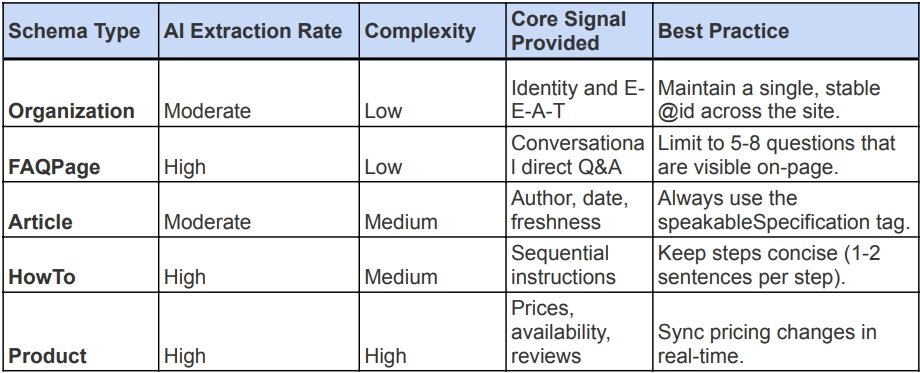
Different schema styles play unique roles in securing search visibility and engine trust. While identity schemas establish overall domain authority, content-specific markup like FAQs and How-To steps drives direct conversational answers. Selecting the right combination of structured data is essential for balancing overall discovery with direct citation extraction.
Let’s compare how different schema types perform across key AI-ready performance metrics.
7. Frequently Asked Questions (FAQ)
Managing structured data involves knowing where to place code, why it matters, and which tools validate your setup. This section addresses common implementation queries to help you execute your SEO strategy flawlessly.
How and where do you put schema markup in an HTML website?
Place your JSON-LD block inside a <script type=”application/ld+json”> tag and insert it into the <head> section of your HTML document. Placing the script in the document header ensures that search engine crawlers parse your structured data before reading the rest of your body text. If you wanted to search where to add schema markup or where to put schema markup in html files specifically, the header remains the industry standard.
Why is schema markup important for generative AI search?
It translates raw human language into organized database nodes that large language models can verify without guessing. AI engines use these structured nodes to resolve ambiguities, map entities, and generate accurate direct answers.
What are the best tools to test and validate schema markup on webpages?
The Schema.org Validator and Google’s Rich Results Test are the industry standards for debugging syntax errors. You can also monitor crawling issues at scale using Google Search Console and Bing Webmaster Tools.
How can I add schema markup to my e-commerce website?
Integrate Product, Offer, and AggregateRating schemas into your site’s dynamic page templates. Ensure your CMS auto-populates these schemas with accurate product IDs, real-time pricing, stock availability, and verified customer reviews. If you wanted to expand your strategy, this dynamic integration is critical for visibility.
8. Conclusion
Understanding how to add schema markup in website folders is no longer optional for technical marketers. While the data shows schema alone won’t instantly generate millions of new clicks, it represents the vital infrastructure needed to stay visible in an AI-synthesized search environment. By deploying robust, validated JSON-LD scripts, you turn vague paragraphs into structured entity graphs that AI search bots trust, parse, and cite. Focus on building clean, authoritative pages, nesting your markup properly, and updating your data elements continuously to claim your spot in modern generative results.
Explore more SEO frameworks, AI-search strategies, and practical digital marketing guides on our homepage.