
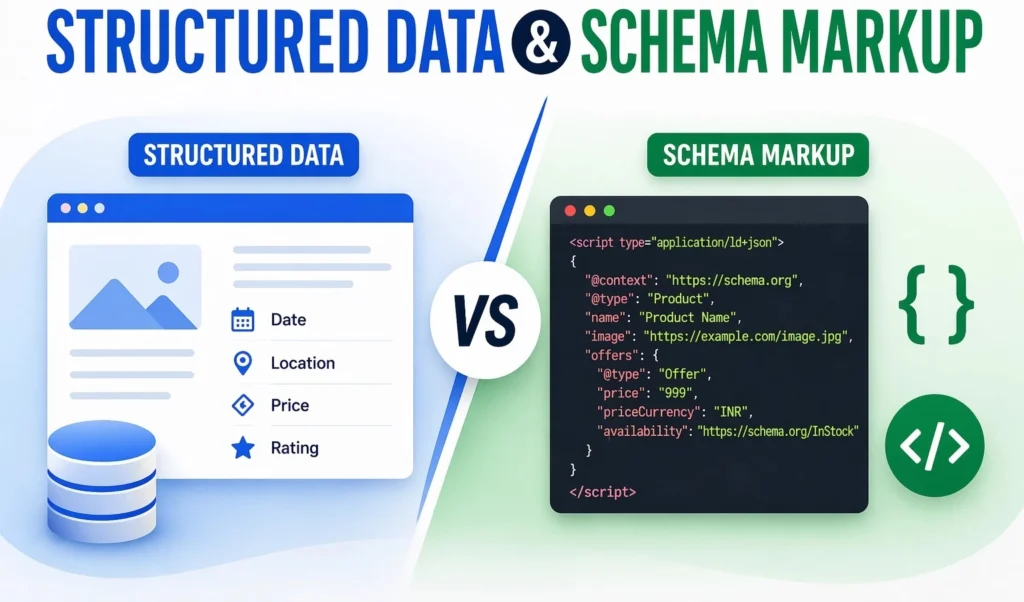
Difference Between Structured Data and Schema Markup: A Simple Guide for Better SEO
If you’ve ever wondered how search engines truly understand your website, you’re not alone. Many beginners get confused about the difference between structured data and schema markup, even though both play a crucial role in modern SEO.
In this guide, we’ll break it down in a simple, friendly way. By the end, you’ll clearly understand what is schema in SEO and what is structured data, and how to use both to improve your rankings and visibility.
What Is Structured Data? (The Foundation of Smart SEO)
Let’s start with the basics: what is structured data?
Structured data is a way of organizing your website content so that search engines can understand it easily. Instead of guessing what your content means, you clearly tell them.
Imagine you run a concert page:
- Date: May 10
- Location: Kochi
- Price: ₹999
A human understands this instantly. But search engines? Not always.
That’s where structured data helps; it labels each piece of information so machines know exactly what it represents.
Key Features of Structured Data:
- Machine-readable format
- Uses a standardized structure
- Helps define relationships (like product → price → review)
- Improves clarity for search engines and AI tools
In simple words, structured data is the concept of organizing content for machines.
What Is Schema in SEO? (The Language Search Engines Speak)
Now let’s answer another common question: what is schema in SEO?
Schema (or Schema.org) is a shared vocabulary that search engines use to understand structured data. It’s like a dictionary that defines different types of content.
For example:
- Product
- Article
- Event
- Recipe
- Review
Each type comes with specific properties like price, rating, author, or date.
So when you use schema in SEO, you’re basically speaking the same language as Google.
What Is Schema Markup? (Turning Ideas into Code)
Here’s where things get practical.
Schema markup is the actual code you add to your website to implement structured data using Schema.org vocabulary.
Think of it like this:
- Structured data = the idea
- Schema = the vocabulary
- Schema markup = the code that applies it
This distinction is essential when understanding the difference between structured data and schema markup.
Difference Between Structured Data and Schema Markup (Explained Clearly)
Let’s simplify it with a quick comparison:
| Aspect | Structured Data | Schema Markup |
|---|---|---|
| Definition | Concept of organizing data | Code implementation |
| Purpose | Helps machines understand content | Applies structured data using schema |
| Format | Abstract idea | JSON-LD, Microdata, RDFa |
| Role in SEO | Improves content clarity | Enables rich results |
In short:
Structured data is the “what,” and schema markup is the “how.”
Types of Schema Markup Formats You Should Know
There are three main formats used to implement schema markup:
1. JSON-LD (Recommended)
- Clean and easy to use
- Preferred by Google
- Placed inside a
<script>tag
2. Microdata
- Embedded directly in HTML
- Harder to maintain
3. RDFa
- Flexible but complex
- Used in advanced cases
Most SEO experts prefer JSON-LD because it’s simple and scalable.
Why Structured Data and Schema Markup Matter for SEO
You might be thinking, does this really impact rankings?
Directly, no. But indirectly, the benefits are powerful:
SEO Benefits:
- Rich Results: Show stars, prices, FAQs in search
- Higher CTR: Up to 25% more clicks
- Better AI visibility: Helps tools like ChatGPT and Google AI understand your content
- Voice search optimization
- Knowledge Graph inclusion
All of this improves your website’s visibility and user trust.
Common Schema Types You Should Use
If you’re just starting, focus on these:
- Article / BlogPosting – for blog content
- Product – for eCommerce
- FAQPage – for FAQs
- LocalBusiness – for local SEO
- Review / Rating – for credibility
- BreadcrumbList – for navigation
These can unlock rich search features and give you an edge over competitors.
Best Practices for Using Schema Markup
To get the best results, follow these tips:
- Use JSON-LD format
- Only mark up visible content
- Choose the most relevant schema type
- Validate using Google tools
- Keep your data updated
- Avoid spammy or irrelevant markup
Done right, schema can future-proof your SEO strategy.
Conclusion: Master the Difference and Boost Your SEO
Understanding the difference between structured data and schema markup is a game-changer for SEO.
- Structured data helps organize your content
- Schema provides the vocabulary
- Schema markup turns everything into actionable code
When combined, they help search engines understand your website better—and reward you with better visibility, richer results, and higher clicks.
If you want your website to stand out in search results, now is the time to start implementing structured data the right way.